When a manufacturer obsessed with competitiveness meets a college intent on reinvention, you get the Wanek Center of Innovation.
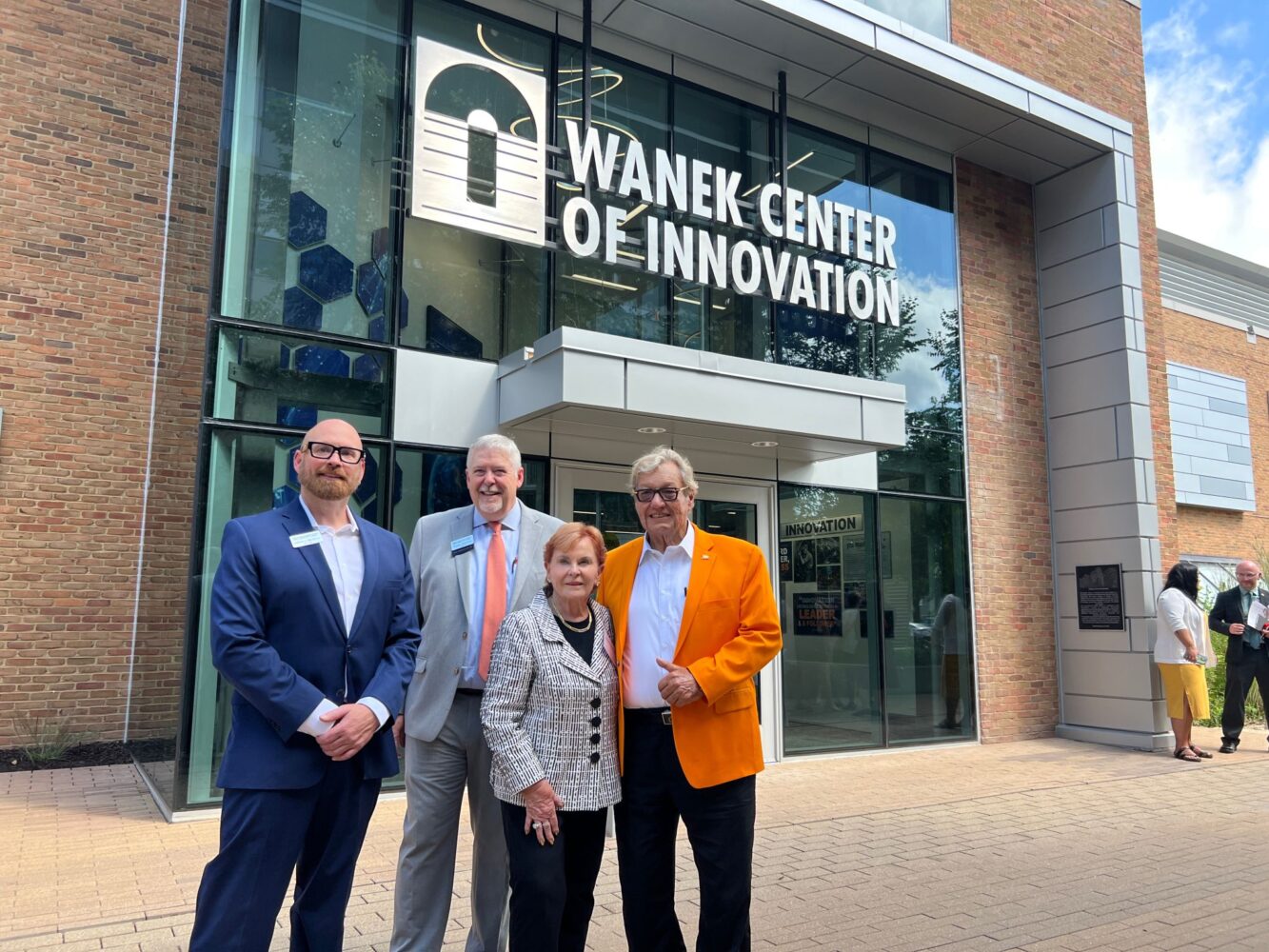
Dr. Josh Gamer, Dr. Roger Stanford, Joyce Wanek, Ron Wanek in front of the new Wanek Center of Innovation at Western Technical College
At Western Technical College in La Crosse, Wisconsin, the Wanek Center of Innovation blends physical and digital technologies designed around how modern factories actually run: networked, data-driven, and AI-aware. The Center has also reengineered their approach to K-12 and university partnerships to create a truly streamlined educational pathway for students. And the entire project was supported by the Ron and Joyce Wanek Foundation.
Ron Wanek, Chairman and Founder of Ashley Furniture Industries, has had the same personal “why” for 60 years: America needs more people who can make things. “The United States hasn’t done the job they need to do in the area of technical education… manufacturing is what creates wealth,” he says, drawing a straight line from STEM skills to a positive balance of trade in America.
It’s this focus on modernizing technical education that drove the Waneks and Western’s leadership team to develop the Center.
The Center is full of emerging technologies, including 39 robots, 3D printers, and advanced training systems. The heart of the Center is a robotics lab with six-axis industrial robots, collaborative robots, SCARAs, and delta robots – all styles of industrial robots used in modern manufacturing. There’s a clear emphasis on FANUC. As the most-used industrial robotics platform in the world, students are most likely to see these same robots when they enter the workforce.
In the center of the lab is a Connected Smart Manufacturing (CSM) system by APT Manufacturing. It’s a fully-functioning, lights-out production line that combines CNC machining, laser etching, and industrial robots for machine tending, material handling, assembly, and packaging. Students learn to program the workcells independently, integrate the system together, and perform maintenance and troubleshooting.
But what’s most unique in the lab is the first-of-its-kind Digital Twin of the CSM. The Digital Twin is an exact digital replica of the live system, built for real-time visibility and scenario testing. Students can simulate changeovers, tweak cell logic, and study throughput or downtime causes in the twin before pushing updates to the physical assets. That means faster learning cycles and safer experimentation on production-grade technology, exactly how modern plants improve their processes.
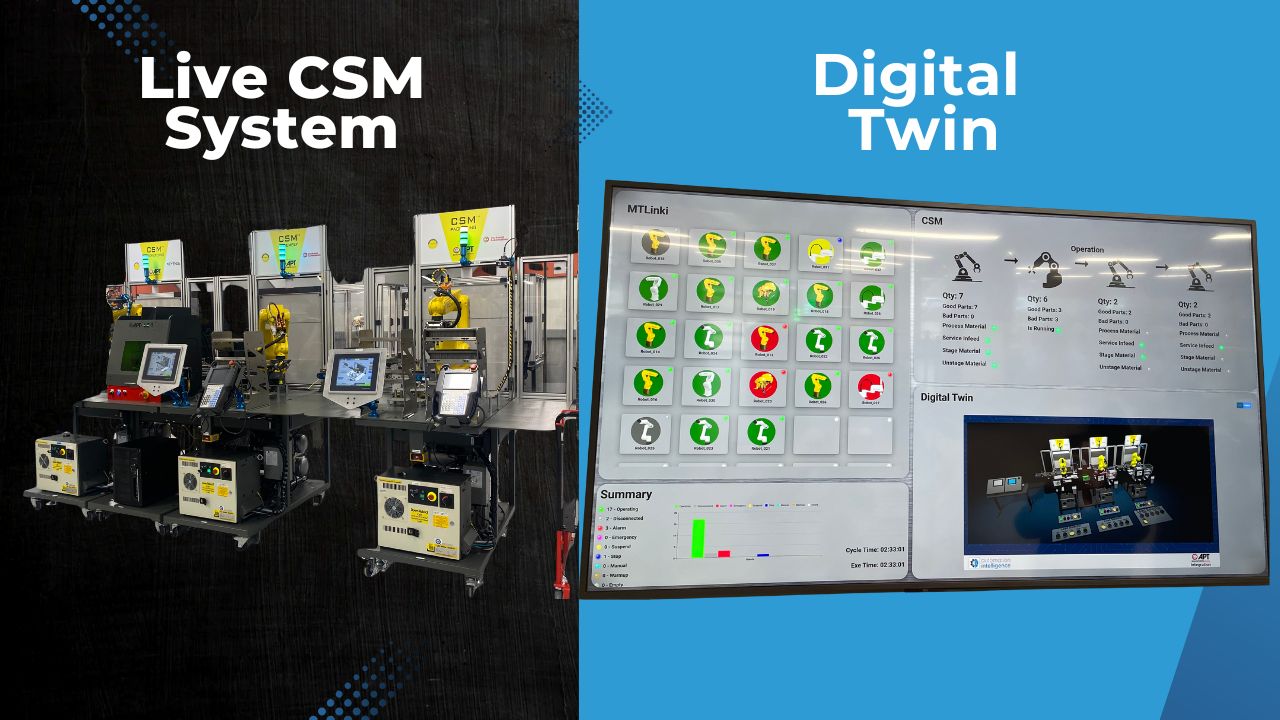 On The TechEd Podcast, Western’s team described how the Digital Twin began with a three-robot cell and then scaled—deliberately—so concepts like flow, buffers, fault recovery, and data collection become tangible, not theoretical.
Ashley Furniture has had a 50 year partnership with Western Technical College, one reinvigorated in 2015 when Western leaders toured Ashley’s plants, recognized their own labs were dated, and committed to reinvest aggressively in advanced manufacturing.
“Education should reflect the employers and communities we’re in,” remarked Dr. Stanford. The college’s commitment to remaining current with advanced manufacturing technology has garnered the support of dozens of employers in the region. Employers are already circling back. Teams who toured the Center during the grand opening have returned with colleagues and begun asking how Western can support their digital transformations—evidence the space is functioning as both classroom and catalyst.
The college is also pushing to remove barriers between K-12 and higher education, as well as the red tape that bogs down transferring credits from colleges to universities.
A full-time K-12 liaison role connects local school districts to dual-enrollment opportunities, where students can take classes in dedicated learning spaces in the Center and earn college credit. Graduates can much more easily step into mechatronics, robotics, and related programs. From there, articulation agreements open direct paths into UW-Stout, including the new B.S. in Automation Leadership. Western and UW-Stout recently signed 13 agreements across disciplines, formalizing 50–80 transferable credits depending on program.
The Automation Leadership degree is designed for exactly this moment in industry: students bring SACA-aligned technical mastery and stack leadership, project management, and digital transformation courses on top, often with up to 88 transfer credits earned before even starting at the university.
That kind of frictionless stackability is precisely what Wanek has argued for: credentials and credits that actually move with students as they advance.
For manufacturers, the advantages are immediate:
This is why Ron Wanek’s challenge resonates: America moves forward when it manufactures, and that requires institutions that teach the technologies and operating disciplines of Industry 4.0, not in isolated courses, but in connected systems students can touch.
The Wanek Center’s model- connected robotics, a real data layer, and an education-ready Digital Twin; K-12 to college to university pathways that truly stack; and an employer-first design philosophy – offers a blueprint any region can adopt. And it’s already working: students are simulating, building, and analyzing on the same platforms their future employers run every day.


