Healthcare may be the highest-stakes proving ground for artificial intelligence.
AI is already being used to help researchers analyze massive datasets, identify drug targets, improve medical imaging, support clinical decision-making, and personalize treatment. In biotechnology, the pace is especially fast. Biotech leader Illumina recently announced its Billion Cell Atlas, the world’s largest genome-wide genetic perturbation dataset, designed to support AI-powered drug discovery by mapping genetic changes across one billion individual cells altered with CRISPR across more than 200 disease-relevant cell lines.
At the same time, AI-enabled medical devices are moving into regulated healthcare environments. The FDA maintains a public list of AI-enabled medical devices authorized for marketing in the United States, giving providers, patients and manufacturers a clearer view of where AI is being used in real medical technology.
That’s the world students are entering.
Most high school students won’t sequence genomes, run clinical diagnostics or design new drugs in a classroom. But they can begin to understand the systems behind modern biotechnology: how biological signals become data, how sensors capture information from the body and the environment, how software interprets that information, and how a device responds.
That’s where Discover AI gives schools a practical entry point.
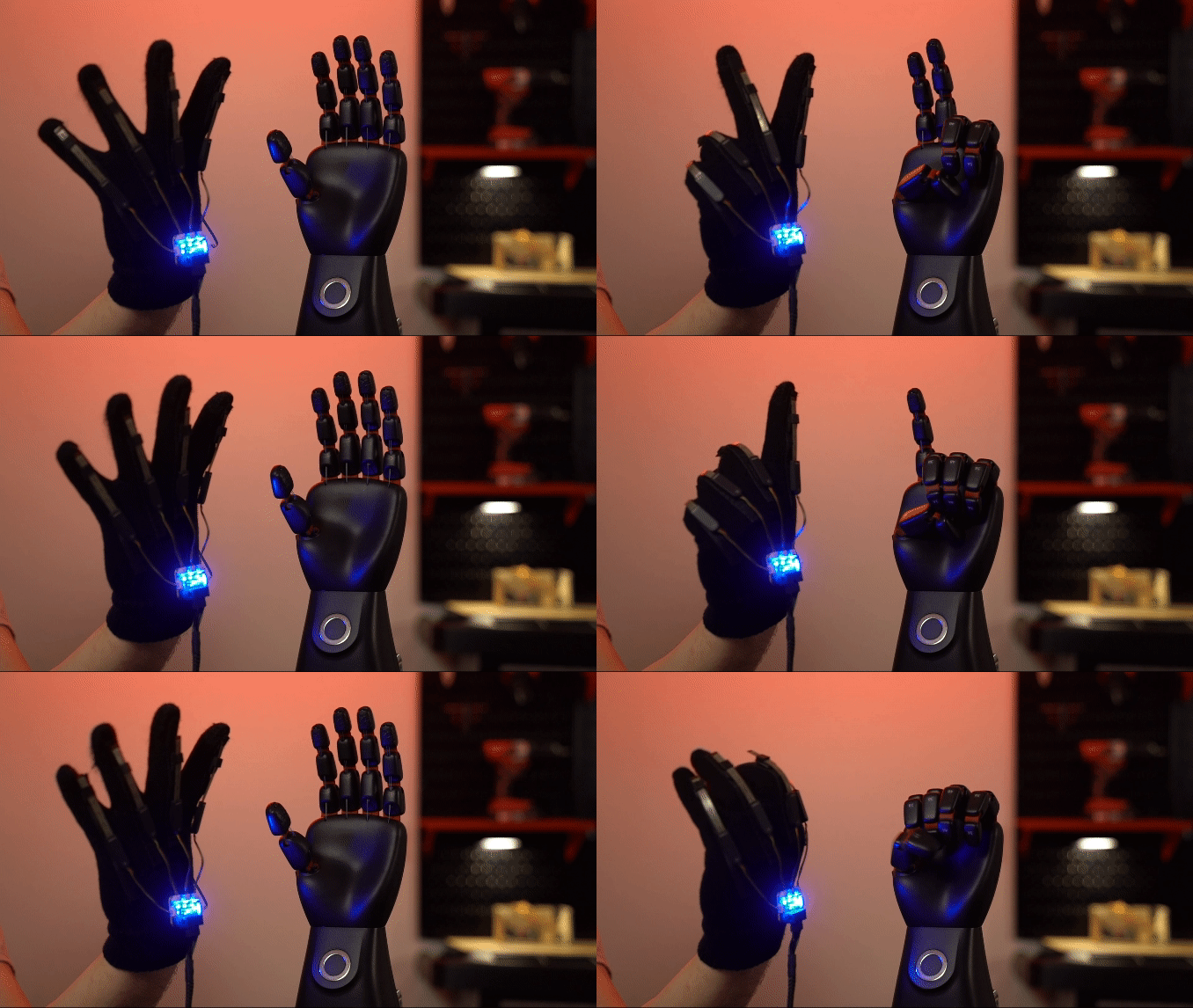
Discover AI is a STEM-focused, applied artificial intelligence program for high schools. Designed to help students explore AI through numerous topics – including biotechnology – Discover AI is a hands-on, project-based approach to AI in the classroom.
In the Biotechnology Experience of Discover AI, students will interact with robotic prosthetic technology, sensors, brain-computer interfaces, and coding as they understand how AI will impact healthcare and wearable medical devices. And it’s all centered around NeuroMaker STEM.
The NeuroMaker Hand 2.0 is a robotic prosthetic hand that students assemble, wire and then program to respond to various inputs in its environment.
It’s a little bit of mechanical design, engineering, programming, neuroscience and applied AI all combined into one device. However, it’s different than any other “robot” you may have in the classroom. Because it’s a prosthetic, students have to think about the human needs behind the design. Can it grip different objects? Can it respond predictably? Can it adapt to shape, distance or motion? Is it durable enough, flexible enough and usable enough for an everyday task? What tradeoffs exist between performance, cost, comfort and control?
Students work through those questions in a series of projects, giving them practice with the engineering concepts and the human-focused healthcare topics.
Applied AI is all about the edge-to-cloud continuum.
At the edge, the physical system is the NeuroMaker Hand itself: the prosthetic hand, fingers, tendons, servos, control box, power source, and the objects it interacts with. It’s also were any AI applications will be applied. The hand has to open, close, grip, release, and perform tasks with enough precision to be useful.
The sensor layer is how the hand gathers information from the user and the surrounding environment. The NeuroMaker ecosystem includes an EMG muscle signal sensor, flex sensor, ultrasonic sensor, IR obstacle sensor, hall sensor, rotary encoder, temperature sensor, RGB color sensor, sound sensor, push button and RGB LED/output modules. Students can work with inputs such as muscle signals, hand motion, distance, color, sound, temperature and brainwave activity.
The onboard microcontroller is the control layer that gathers all the data from those sensors and tells the hand how to respond: adjust a grip, react to a distance threshold, follow a gesture, or translate muscle activity into a hand movement. Students can use the NeuroMaker Core controller or any other compatible third-party microcontroller including Micro:bit, Arduino, Raspberry Pi or Adafruit.
The cloud/AI layer, a local computer hosts block-based and Arduino programming options, where students set up programming environments and apply conditionals, events, sequences, loops, variables, and functions to control the hand.
With this approach, you’re making AI less abstract for students. They’re not just learning terms like “machine learning” or “automation.” They’re seeing how a system captures data, interprets it through software, and produces a physical response.
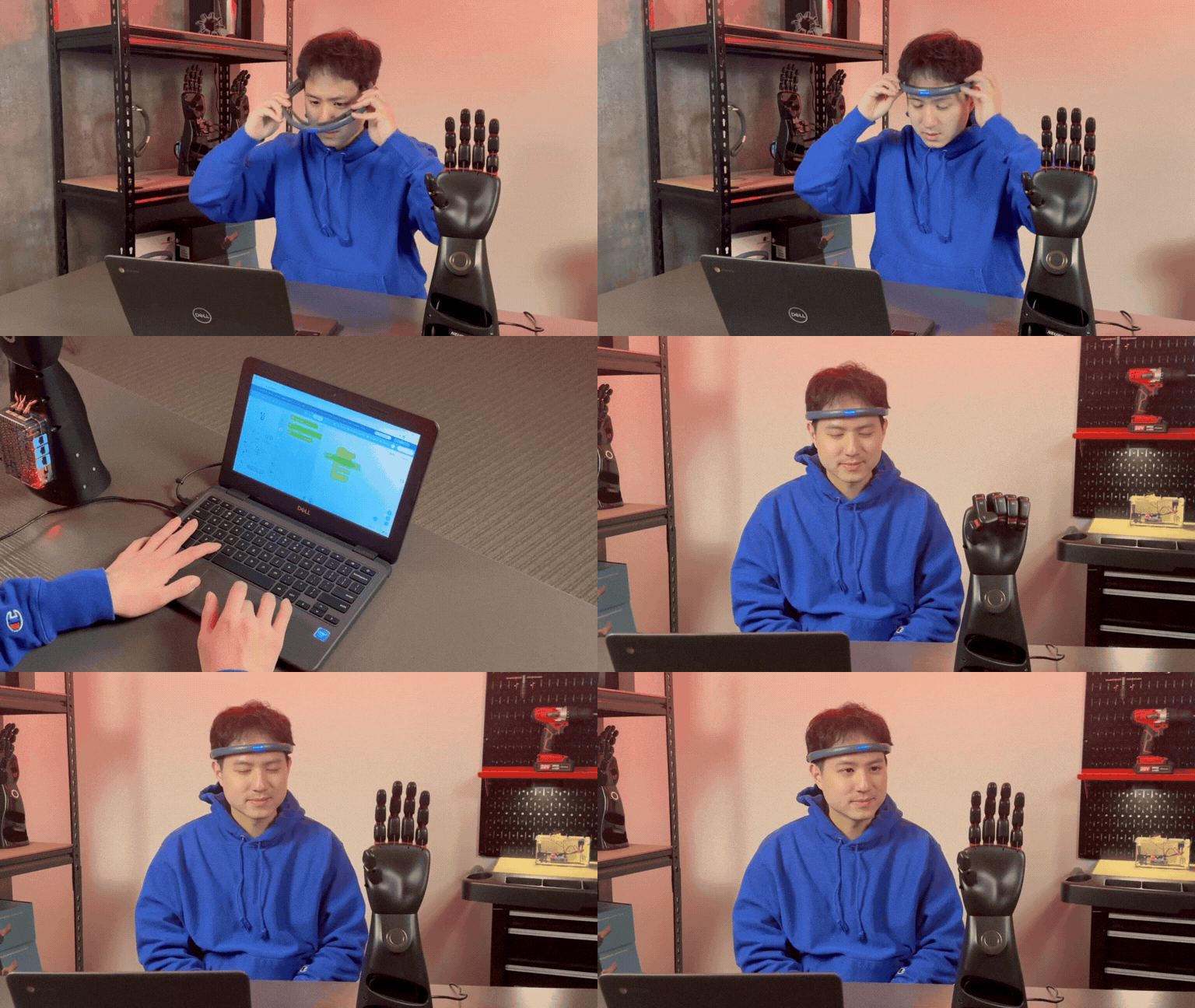 The Discover AI Biotechnology Experience turns those edge-to-cloud concepts into a structured sequence of hands-on learning. Students begin by assembling the NeuroMaker Hand, identifying its mechanical and electrical components, and understanding how servos, tendons, controllers, wiring, sensors and power sources work together to create movement.
From there, they move into the biomedical engineering side of the system: neuroscience, body systems, prosthetics, the human hand, grip design and brain-machine interfaces. Because the device is modeled around a prosthetic hand, students have to think beyond whether the technology “works.” They have to consider whether it works for a person: Can it grip different objects? Can it adapt to shape and pressure? Is it comfortable, durable, affordable and usable?
Programming then gives students direct control over the hand’s behavior. Using block-based and Arduino programming concepts, they build projects around object detection, gesture matching, EMG muscle signals and autonomous hand movement. They’re learning applied programming in real-time. If a sensor threshold is wrong, the hand reacts incorrectly. If the logic improves, the hand performs the task more effectively.
The capstone brings everything together in a human-centered challenge. Students design and enhance the prosthetic hand to complete everyday tasks in a simulated grocery store environment, then prototype, test, evaluate and present their solution.
Discover AI is a modular, hands-on and project-based platform to bring applied artificial intelligence into high schools. It consists of an introductory eLearning course to help students understand how AI and machine learning work in the real world, then provides students the freedom to explore 45-hour courses in 12 different STEM fields like smart manufacturing, agriculture, energy, biotechnology, drones, self-driving cars and more.
To learn how to bring Discover AI to your school, contact LAB Midwest.


